What distro of Linux should we target? Should we target Ubuntu like LiveCode did, or is there a more popular version we should aim for?
That’s a great question - there are a lot of distributions out there. If I had to pick, I’d go with Ubuntu or Debian - reliable, well-behaved, and unlikely to ruin your day before coffee.
And of course, my personal favorite: Raspberry Pi. If there’s any way to make a version for it, that would be fantastic.
I can already imagine the Raspberry Pi crowd getting very excited - possibly to the point of immediately flashing SD cards before reading the instructions 
1 Like
Ubuntu. Among the most popular, on the desktop has been the clear leader for years.
Great core team, committed contributor base, huge ecosystem, solid funding.
From there hopefully others will be inspired to make forks as needed for other distros. But making Ubuntu the first target is a solid choice.
1 Like
Less critical in terms of everyone else, but interesting for me personally, would be to see what’s needed to support Kubuntu.
I’ve been poking around with KDE and I’m kinda impressed. I like the KDE design ethos, and have much respect for the Kubuntu maintainer.
But to get started, ignore this message and do Ubuntu first.
You’re smarter than me, but if there’s anything I can help you find with Ubuntu let me know.
I doubt that. I might have lots of Linux questions, especially if I can’t find the answers online.
1 Like
This is on the roadmap, have to see how much work it is though
1 Like
When using Linux, be forewarned: with everything open and moddable down to the source, tinkerers like yourself have been known to have become addicted. There is no known cure. Some of the more seriously afflicted even become kernel contributors. You have been warned. 
1 Like
lol I don’t know if I’ll become a kernel contributor, I have my hands full with HyperXTalk.
I’ve used Ubuntu but am currently enamoured with Arch (specifically Omarchy). AppImages are a very Secure way to make sure apps work.
1 Like
To work against a reputation of voting refusenik, I will say that it is mostly Mint or Ubuntu here, because this works out of the boxish. Just for a reliable stream of HXT Linux builds I would change distributions anytime where necessary. 
1 Like
I know nothing about Linux, so this discussion is good to have
- Omarchy
- Ubuntu
- Mint
- Kubuntu
Those are the distros mentioned in this thread.
I would argue Omarchy works “more” out of the box on old macs that mint/ubuntu does. It’s the only installation I’ve made on a couple of old macs where WiFi just worked out of the box. All function keys work perfectly intact everything except webcam and that was a simple matter to fix following Claude AI.
it’s a different concept (tiled and / or scrolling windows that make switching desktops actually meaningful, instead of the tired old desktop paradigm). Most things you’d want are installed out of the box and its package manager pacman has official app versions. Pretty much everything else is available in the AUR, since this is an Arch based system. It’s fully configured and set up for dev work (hence the author calls it “opinionated”, but that mean 99% of stuff works out of the box fully configured. But you are not limited to that: for example it was crazy easy to install stream with the Proton layer that lets you just run windows games directly. And so on…
Have a look at this YouTube to get an idea:
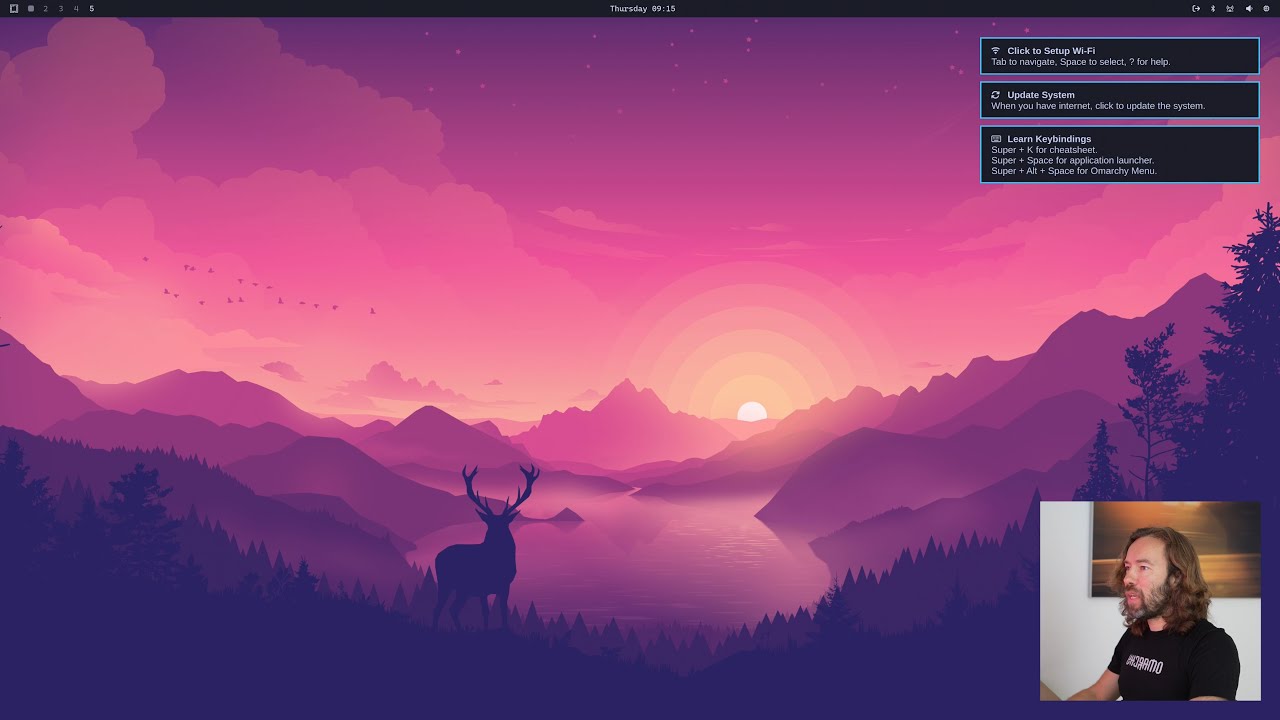
This video got me intrigued and I installed it on an aging 2015 MacBook Air. Haven’t looked back! (And yes, I have both community LC and Xojo running in this. I did have to install some dependencies for LC to work but Claude (pre-installed ahead its own shortcut cmd-shift-A) makes light work of such things…
wow that’s an interesting OS. I don’t think it’s for me though as I’m a point and click type of girl 
That’s the beauty of it, it is all point and click as well, but the key combos add an amazing dimension that is difficult to describe. I find myself wanting to to have a similar tiled interface on my Mac too now…
It’s very different and you really have to use it to get it. Linux Mint is probably the safer bet for a Mac/win analog where most things work and seem familiar - that was certainly my starting point. Especially if you want to dual boot (Omarchy be default takes over the whole drive).
Notoriously tho WiFi is problematic with Ubuntu based distros like Mint on old macs (chatGPT can usually resolve this but it means you’d need to Ethernet it to start with)…
Well, I think we’re going to install Linux on the Thinkpad (I heard it was a good choice ) If LiveCode Community runs on Omarchy, surely HyperXTalk should be able to as well.
The longer I work in tech the more I pay attention to ecosystem size as a key to choosing platforms, whether a CMS or an OS or any other infrastructure.
For adoption of a tool like HyperXTalk, the sheer numbers, coupled with the broader demographics, favor Ubuntu.
Other distros can be supported as time permits, but the Ubuntu ecosystem will get the most eyeballs most quickly.
Well, someone had mentioned https://flatpak.org as a way of not worrying about which distro is being used. Do you think that would be helpful?
Ah, the many competing packaging options in the Linux multiverse…
Flatpak is available for Ubuntu, but I’m not sure it’s installed by default.
Ubuntu favors the Snap packager, which is installed by default not not on as many distros.
Perhaps the best option for coverage while we wait for the various itch-scratching in the Linux multiverse to sort itself out would be an installer similar to the one LC had used.
Yes, can always reuse the LiveCode installer. I got rid of it on macOS as it’s not very “Mac-like”
It’s not very Linux like either, but it’ll do for now. If we get traction I might create a .deb package for it and submit it to an Ubuntu PPA repository so it can be installed the way most software gets installed. But one step at a time…